
Chinese Festivals & Remembrance
Hungry Ghost Festival 2026 in Singapore — Customs, Do’s and Don’ts, and Flower Offerings
May
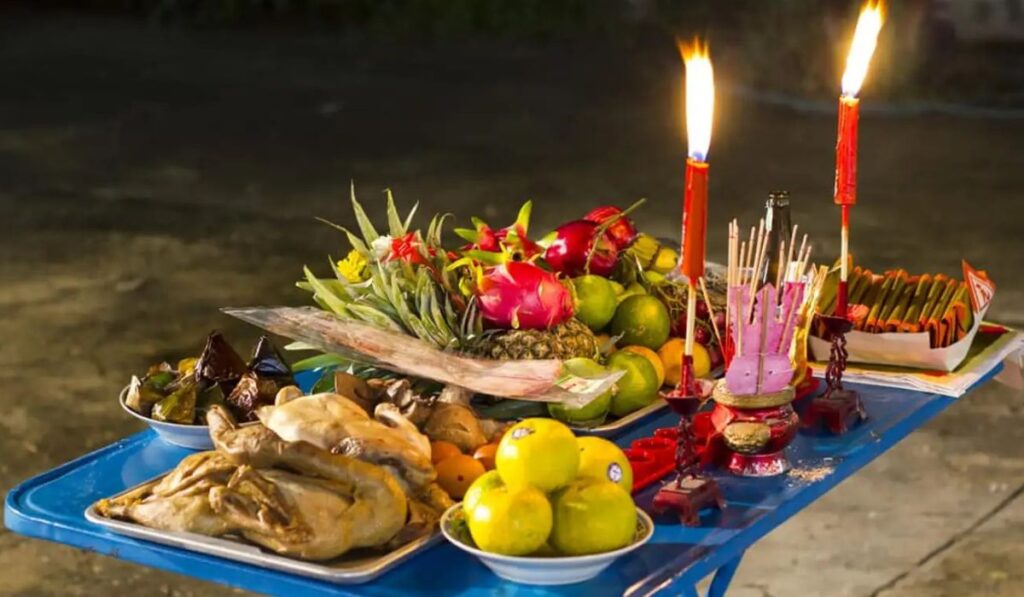
If you have lived in Singapore for any length of time, you know the signs. Suddenly, on certain evenings in August or September, the void deck of your HDB block is filled with small red candles, joss sticks burning in pots of sand, and platters of cut fruit set out on low tables. Acrid smoke drifts up from the metal bins by the carpark — neighbours quietly burning joss paper. Somewhere within walking distance, a temporary stage has gone up overnight, draped in red banners and equipped with surprisingly loud speakers. This is the 7th lunar month, and it is among the most observed periods in Singapore’s Chinese cultural calendar.
The Hungry Ghost Festival (中元節 Zhōng Yuán Jié) — or simply Ghost Festival — is a Taoist and Buddhist tradition with deep roots in Chinese folk religion. For the entire seventh lunar month, beliefs hold that the gates of the underworld are open and wandering spirits return to the world of the living. Some of these spirits are honoured ancestors. Many are hungry ghosts — wandering souls with no descendants to make offerings to them, who must be appeased so they do not bring misfortune. The customs of the month exist to honour both.
This guide is for anyone living in Singapore who wants to understand what is happening around them during ghost month — whether you observe the customs yourself, are deciding whether to send flowers to honour a family member during this period, or simply want to know why your neighbour is burning paper in a metal pot at 8 PM on a Tuesday. We cover what the festival is, when it falls in 2026, how Singaporeans observe it, the rules that govern the month, and the appropriate flower offerings for family altars and ancestral tributes.
The Hungry Ghost Festival is observed throughout the entire seventh lunar month of the Chinese calendar. In 2026, this falls in August and September. Because the Chinese calendar is lunar, the exact start and end dates shift each year relative to the Gregorian calendar — you cannot mark August 14 as “ghost month” the way you can mark December 25 as Christmas.
Three key dates structure the month:
- The 1st day of the 7th lunar month — the gates of the underworld are believed to open. Offerings begin.
- The 15th day — Zhong Yuan Jie (中元節), the official Ghost Day. The most heavily observed day of the month. Public offerings peak. Temples conduct major ceremonies.
- The last day of the 7th lunar month — the gates close. The spirits return to the underworld. The month is complete.
What the Festival Is and Where It Came From
The Hungry Ghost Festival has roots that predate any single religion. Its current form is shaped by both Taoist and Buddhist traditions, layered over centuries of Chinese folk belief. Each tradition gives it slightly different emphasis, but the core idea is shared: during the seventh lunar month, the boundary between the living and the dead is thinner than usual, and the dead return.
In the Taoist tradition, the festival is called Zhong Yuan Jie (中元節) — the Middle Origin Festival, one of three “Yuan” festivals that mark the year. The gates of Diyu (地獄, the underworld) open on the first day of the month, releasing all spirits — ancestors, the recently dead, and the wandering souls who have no family to remember them.
In the Buddhist tradition, the same period is observed as Yu Lan Pen (盂蘭盆, the Ullambana Festival), drawn from the legend of the disciple Mulian who descended to the underworld to save his suffering mother. From this story comes the practice of offering food and prayers to relieve the suffering of one’s ancestors.
What unites both traditions, and what defines the festival in modern Singapore, is the practice of making offerings. Food, joss paper, incense, prayers, and entertainment — all extended to the spirits, both the ones you love and the ones you do not know but fear may otherwise cause harm if neglected.
How Singapore Observes Ghost Month — A Walkthrough
Ghost month in Singapore is unusually visible compared to most other Chinese-majority territories. Hong Kong, Taiwan, mainland China all observe the festival, but the public dimension — temporary stages, public offerings, communal feasts — has a particular vitality here. Some of this is the result of the HDB landscape: the void deck below every block of flats provides exactly the kind of semi-public, communal space the rituals require.
The void deck altar
If you walk through any HDB estate during ghost month, you will see them — small temporary altars set up in the void deck or at the side of the block. A low table covered with red paper. Joss sticks burning in pots of sand or rice. Platters of cut oranges, apples, pears, bananas. Sometimes whole roast chickens, packets of rice, cans of beer, cigarettes — whatever the family believes their ancestor or the visiting spirits would have appreciated in life.
The altars are erected by residents on behalf of either their own family ancestors or, increasingly, by groups of neighbours pooling resources to make offerings to the wandering ghosts who have no family. Many altars stay up for the entire month; some are set up only on Ghost Day itself.
Joss paper and incense
The most distinctive sound and smell of ghost month is the burning of joss paper. Walk past any HDB block in the evenings of the 7th lunar month and you will encounter the metal bins — black, often with a fork or stick to push papers down — burning steadily on the grass verges, in carparks, at the corners of estates. Inside the bins, joss paper (金银纸 jīn yín zhǐ, gold and silver paper) is burning, sending offerings of currency, clothing, even paper houses and paper cars to the spirit world.
The intention is simple. Hungry ghosts, by their nature, lack. They wander without descendants, without inheritance, without home. Burning paper money and paper goods provides them with currency and possessions in the spirit realm, easing their hunger and reducing the likelihood that they will trouble the living.
For families burning paper for their own ancestors, the same logic applies — ensuring loved ones have what they need in the afterlife. The paper itself is sold widely in Singapore: at temples, at provision shops, at HDB neighbourhood stalls that appear specifically for the month.
Getai (歌台) — Singapore’s unique tradition
Of all the observances of ghost month, none is more distinctively Singaporean than Getai (歌台, literally “song stage”). Temporary stages are erected in carparks, fields, and open spaces, hosting live variety shows that run for several nights at a time. Singers, comedians, dancers, hosts — all in elaborate costume, all performing to an audience that sits on rows of red plastic chairs.
The front row is conspicuously left empty. The first row of every Getai stage is reserved for the spirits — the deceased ancestors and wandering ghosts who, by tradition, are the true audience the performances are intended to entertain. Sitting in those seats is considered taboo even by the most secular Singaporean. Photos of empty Getai seats with the stage glowing behind them are part of the visual language of Singapore’s ghost month.
The Getai tradition has evolved over the years — from solemn opera performances in earlier generations to pop music, dialect comedy, and electronic music sets today. It is, in many ways, a uniquely Singaporean expression: a Chinese religious tradition translated into a modern, communal, performative form.
Vegetarian offerings to monks
In the Buddhist Yu Lan Pen tradition, the centrepiece of the festival is offering vegetarian food to monks, who then chant for the relief of suffering souls. Singapore’s larger Buddhist temples — Kong Meng San Phor Kark See, Bright Hill Temple, Buddha Tooth Relic Temple — host significant Ullambana ceremonies. Families who follow the Buddhist tradition often attend these temple services in addition to making private offerings at home.
For Taoist families, the equivalent is the formal Zhong Yuan ceremony at Taoist temples — the major Taoist centres in Singapore conduct elaborate prayers and offerings, particularly around the 15th day.
The Do’s and Don’ts of Ghost Month in Singapore
The customs of ghost month are unusually elaborate when it comes to what one should not do. Many Singaporeans — including those who do not personally believe in spirits — observe the don’ts to some degree. Whether out of respect for older relatives, cultural habit, or quiet superstition, the conventions are widely followed. Here is what to know.
What you should do during Ghost Month
- Make offerings if you observe the tradition. Joss paper, fruit, candles, and incense at a small altar honour both your ancestors and the wandering ghosts. The offerings need not be elaborate — sincerity matters more than scale.
- Walk around offerings on the ground, not through them. Even if you do not believe, stepping on or through food, candles, or joss paper laid at the side of a road or void deck is considered deeply disrespectful. Walk around.
- Bring flowers to your family’s ancestral altar. White and yellow chrysanthemums, lilies, or a funeral orchid plant are appropriate offerings during the month, particularly leading up to Ghost Day.
- Attend a temple ceremony if you observe the tradition. Yu Lan Pen ceremonies at Buddhist temples and Zhong Yuan ceremonies at Taoist temples are open to the community.
- Be respectful around Getai shows. If you attend, sit anywhere except the empty front row. Enjoy the performances. They are part of the tradition.
- Visit your family’s columbarium niche or grave. Bringing fresh flowers and making prayers at a loved one’s resting place — at Mandai, Choa Chu Kang, or any other Singapore columbarium — is appropriate throughout the month.
What you must never do during Ghost Month
- Do not whistle at night. Whistling after dark is believed to attract spirits’ attention. The same applies to humming aimlessly or making strange noises in the dark.
- Do not pick up money or red packets found on the ground. Cash or hong bao left on the street during ghost month may be ritual offerings to the spirits. Picking them up is believed to invite their attention and their misfortune.
- Do not stand under trees after dark. Trees are said to attract wandering spirits, particularly large old ones. Avoid lingering beneath them at night.
- Do not sit in the front row at Getai shows. Those seats belong to the spirits. Sitting in them is the most well-known and widely observed Getai taboo.
- Do not move house, hold a wedding, or start a major venture. Ghost month is considered inauspicious for new beginnings of any kind. Property prices in Singapore visibly soften during ghost month for exactly this reason — buyers and sellers wait.
- Do not swim alone at night or in unfamiliar waters. Drowning spirits are believed to seek replacements during ghost month. The custom may be old, but the safety logic — do not swim alone in unfamiliar water — is permanently sound.
- Do not take photos of empty Getai seats. Photographing the empty front row is believed to capture the spirits sitting there. Many Singaporeans avoid this even casually.
- Do not kick or step on roadside offerings. Whether food, candles, or joss paper, walking through offerings — particularly accidentally kicking them over — is considered deeply disrespectful to the spirits being honoured.
- Do not stay out late if you can avoid it. The general principle of ghost month is to keep human activity earthbound and daytime. Late-night wandering in cemeteries, parks, or quiet streets is best avoided.
- Do not hang clothes outside overnight. Wandering spirits are said to “try on” clothing left outside. Bring laundry in before sunset.
Flowers for the Ancestral Altar During Ghost Month
For families who maintain a home altar to deceased relatives — increasingly common in Singapore — ghost month is the most significant period for flower offerings outside of the death anniversary itself and Qing Ming. The flowers placed at the altar are part of the same logic as the food and joss paper: an offering to the visiting ancestor, a sign that they are remembered.
Appropriate flowers follow the same conventions as flowers at a Chinese wake:
| Flower | Why it’s appropriate |
|---|---|
| White chrysanthemum | The classic Chinese mourning flower. Always correct for ancestral remembrance. |
| Yellow chrysanthemum | Symbolises longevity and respect. Appropriate alongside white. |
| White lily | Represents purity and the soul’s journey. Common at altars. |
| White phalaenopsis orchid | Long-lasting plant the family keeps. Suitable for the entire month. |
| Yellow carnation | Modest, respectful. Frequently used in family altar arrangements. |
Never bring red flowers, pink flowers, or brightly mixed arrangements to an ancestral altar. The same rules that govern Taoist funeral flowers and Buddhist funeral flowers apply here. White and yellow only.
For families who do not maintain a home altar but wish to make a flower offering during ghost month — to honour a deceased parent, grandparent, or loved one — a funeral orchid plant delivered to the family home is a thoughtful gesture. The plant lasts the full month and beyond, and the family can place it wherever they observe their ancestors’ memory.
After the Festival — Closing the Gates
On the last day of the seventh lunar month, the gates of the underworld are believed to close. The spirits return. The month is complete. The Getai stages come down. The metal joss-paper bins disappear from the void decks. Singaporeans return to making major decisions — buying property, scheduling weddings, opening businesses.
For families who have observed the month with intention, this is a quiet moment. The ancestors have been honoured. The wandering spirits have been appeased. The household altar can return to its everyday rhythm until the next major remembrance — Chong Yang Jie (重陽節) in the 9th lunar month, the death anniversary of a specific ancestor, or Qing Ming the following spring.
Sending Flowers for Ghost Month or a Family Altar?
White and yellow ancestral arrangements — delivered in 90 minutes, 24/7
FFS has served Singapore’s Chinese community for ghost month, Qing Ming, and every remembrance occasion since 2010. White chrysanthemums, yellow carnations, orchid plants for the altar — all delivered fresh, anywhere in Singapore. Open every day of the year, including throughout ghost month.
Frequently Asked Questions
When is the Hungry Ghost Festival in 2026?
+
What are the main don’ts during Hungry Ghost Month in Singapore?
+
Can I send flowers to a family during Hungry Ghost Month?
+
What is the difference between Hungry Ghost Festival and Qing Ming?
+
Why is the front row at Getai always empty?
+
Is it safe to take photos of joss paper burning or altar offerings?
+
Can non-Chinese visitors observe or participate in ghost month customs?
+
